
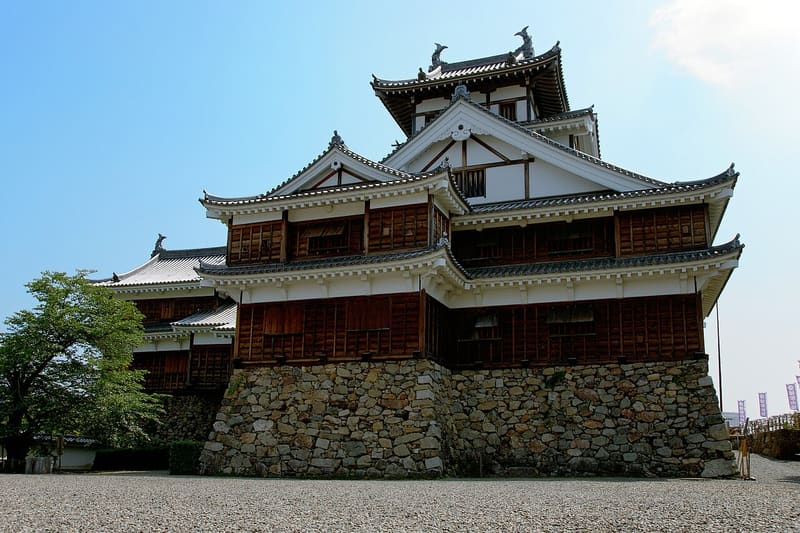
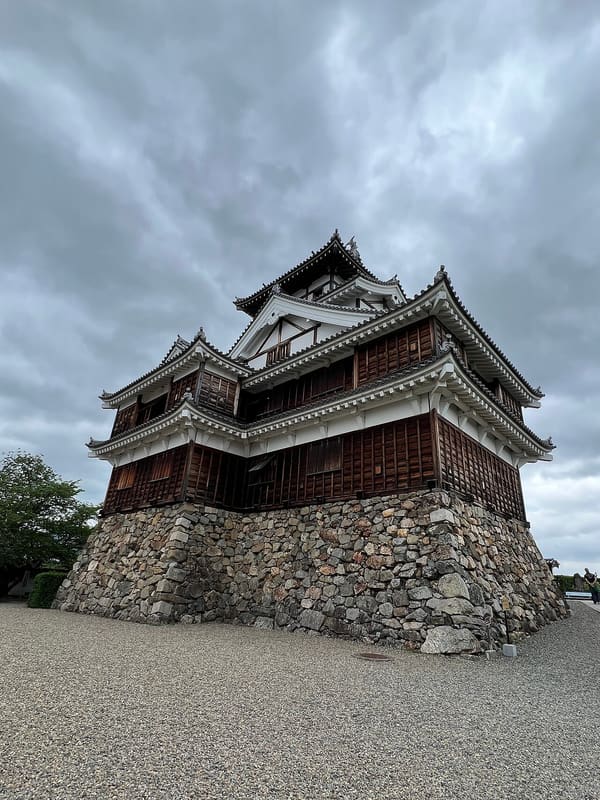
Its walls contain over 500 stones stolen from temples: gravestones, statues, millstones.
The reused stones (転用石, that is, building material taken from dismantled religious buildings) can be recognised with the naked eye in the base: they are stupas, statues of the Buddha, millstones, fitted in like the others. The most recent bear a date of 1575, the year in which Akechi Mitsuhide, the general who built the castle here after subduing the region, needed it urgently and had no time to quarry new stone. The present castle, a three-storey tower (天守, tenshu), is a 1986 reconstruction: the real one was dismantled in 1873.
It was built by Akechi Mitsuhide between 1579 and 1582 as the base of his rule over Tanba, the inland region north-west of Kyoto (the same Mitsuhide who shortly afterwards would betray and kill his lord, Oda Nobunaga). The tenshu, the castle's main tower, was pulled down in 1873 with the abolition of the feudal system and rebuilt in concrete in 1986 following the historical plans.
ℹ️ Main tower open 9:00–17:00 (last entry 16:30), 360 yen for adults, 110 yen for students. Closed from 28 December to 6 January. Inside, a museum on Mitsuhide and the history of the city. The park around the tower is free to enter.
🚉 Fukuchiyama · 16 min walk
Holidays in Japan? Plan them with us.Over 2,000 real places, a day-by-day itinerary.FreeOpen the map →Sources: city.fukuchiyama.lg.jp · bunshun.jp · kojodan.jp