
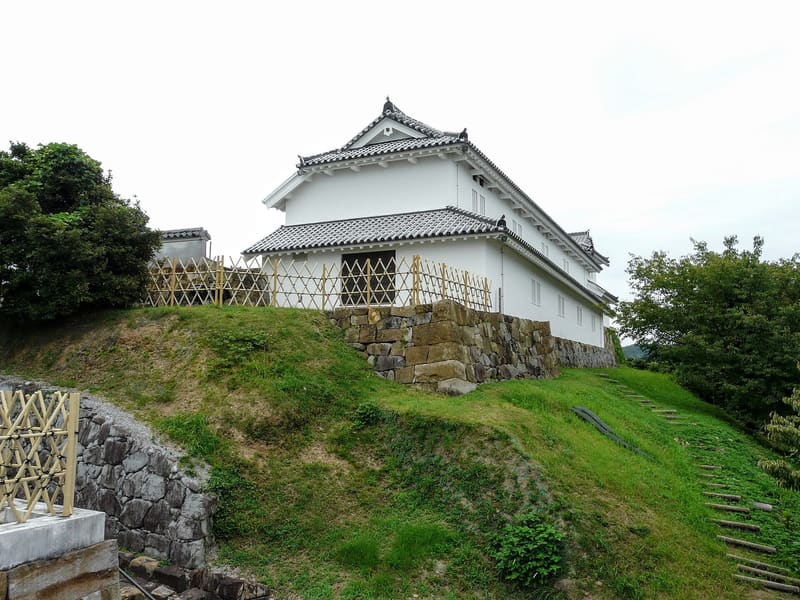
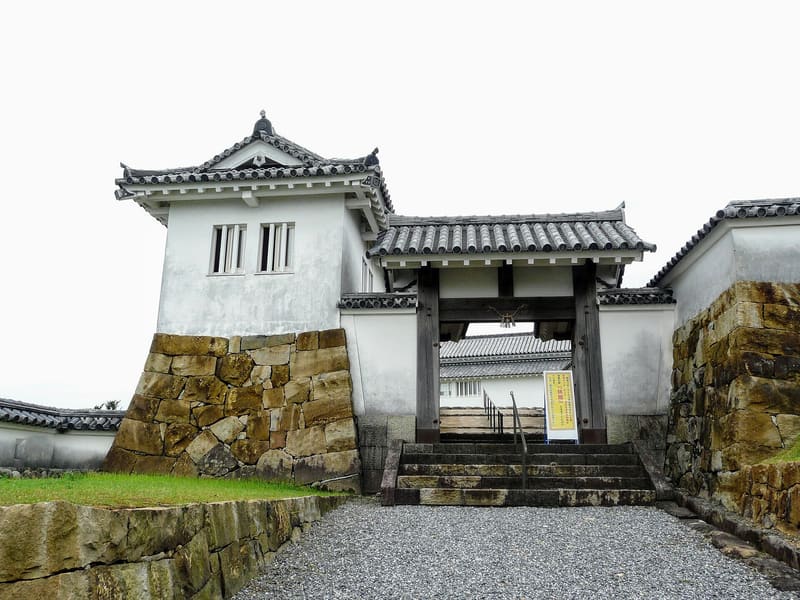
It withstood the rebels' siege in January 1638; the rebuilt turret is a visitor centre.
You enter by the reconstructed gate and go up to the honmaru, where the turret houses the visitor centre: in front of a three-panel screen, the seabed of Amakusa scrolls past. From the walls you can see the Fukuro-ike pond, which served as a moat, the port and Tomoe Bay. Lower down, in the ninomaru, are the town museum and the statue of Suzuki Shigenari, first administrator of the islands after the revolt.
It was built between 1602 and 1605 by Terasawa Hirotaka, lord of Karatsu, who in 1601 had received Amakusa (42,000 koku, the income in rice) for serving the eastern side at Sekigahara. It stands on a hill joined to the mainland by a sandbar, with the Fukuro-ike pond to the south and Tomoe Bay to the east, which protected it. In the Shimabara-Amakusa rebellion the rebels attacked it on 4 January 1638, after killing the castle warden Miyake Tōbei at Hondo; the commander Harada Iyo held out, and on 10 January the rebels withdrew and moved on to Hara Castle. After the rebellion the Terasawa house lost Amakusa. In 1670 Toda Tadamasa had the honmaru and ninomaru demolished so as not to burden the inhabitants, and the sannomaru (the third enclosure) remained the seat of the shōgun's direct administration until the Meiji Restoration. Between 1994 and 2005 the walls, turret and gate were rebuilt on an old plan; the turret of the honmaru is modelled on the long hall (多聞櫓) that really existed.
ℹ️ The castle is an open area, with no ticket and no published opening hours. Visitor centre (ビジターセンター): 9:00–17:00, free, closed on Wednesdays (if a public holiday, the day after) and on 30–31 December and 1 January (prefecture page, updated 15/08/2023). Reihoku Historical Museum (苓北町歴史資料館) in the ninomaru: 9:00–17:00, last entry 16:30, closed on Thursdays (if a public holiday, the day after), 100 yen from high school upwards, free up to junior high (town prices from 2025, to be rechecked); it is a different building from the visitor centre, with a different closing day. The climb on foot is steep (2019 review); by car you can get almost to the top, but the road is narrow and the car parks are confusing (2026 review): the most convenient one has few spaces, and the ninomaru one is reached from another road. The Sankō bus ‘Amakusa-go’ from Kumamoto arrives at 本渡バスセンター, then a bus bound for 富岡港 to the ‘一丁目’ stop and 14 minutes on foot (1.1 km), according to Wikipedia; timetables not read. From Nagasaki (Mogi port) a fast boat reaches Tomioka in 45 minutes. Every year at the end of October there is the castle festival: on 25/10/2026 the 10th edition, with a stage on the Hyakken-dote embankment (about 17 groups), five activities (a walk to the castle, a boat trip, regattas, archery, e-bikes) and a photography contest.
🚉 富岡港船客待合所 · 16 min walk
Holidays in Japan? Plan them with us.Over 2,000 real places, a day-by-day itinerary.FreeOpen the map →Sources: pref.kumamoto.jp · kankou.reihoku-kumamoto.jp · kankou.reihoku-kumamoto.jp · kankou.reihoku-kumamoto.jp · ja.wikipedia.org
Nearby
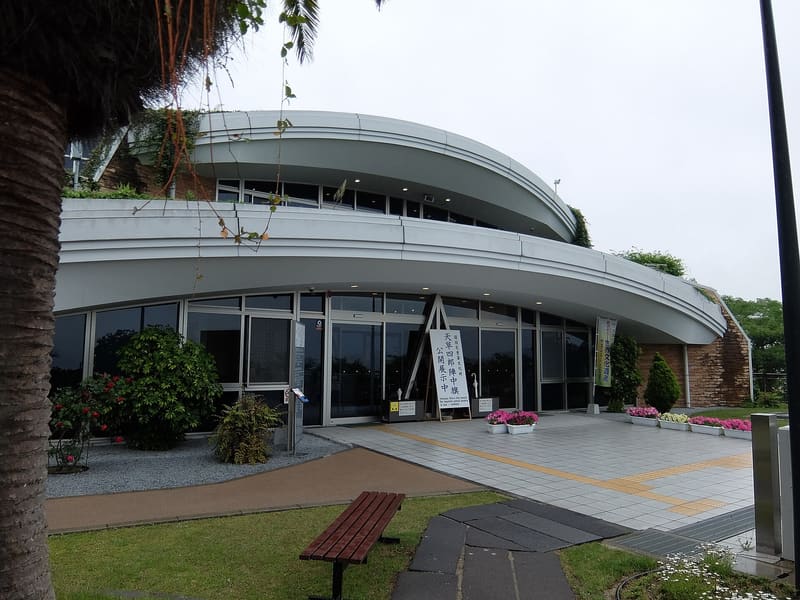 Amakusa Christian Museum16.3 kmphoto by Ippukucho · CC BY 3.0
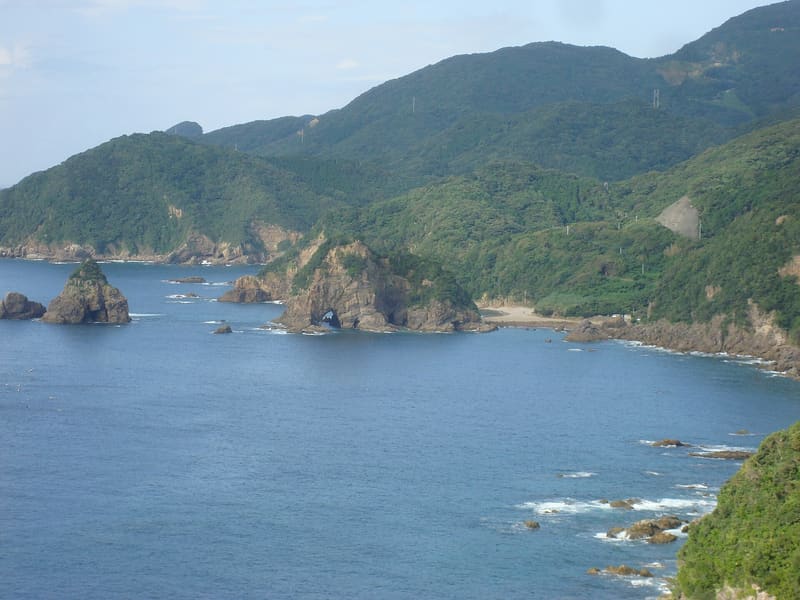 Myōken-ura Coast16.4 kmphoto by Airick25 · CC BY-SA 3.0