The Anime Trip
🌐 EN ▾
ItalianoEnglish繁體中文(台灣)繁體中文(香港)日本語
PLAN YOUR TRIPMy tripSign in / Sign upSign in / Sign up

Kumamoto

Kitazato Shibasaburō Museum

北里柴三郎記念館

Open on the mapwith over 1,800 wonders of Japan

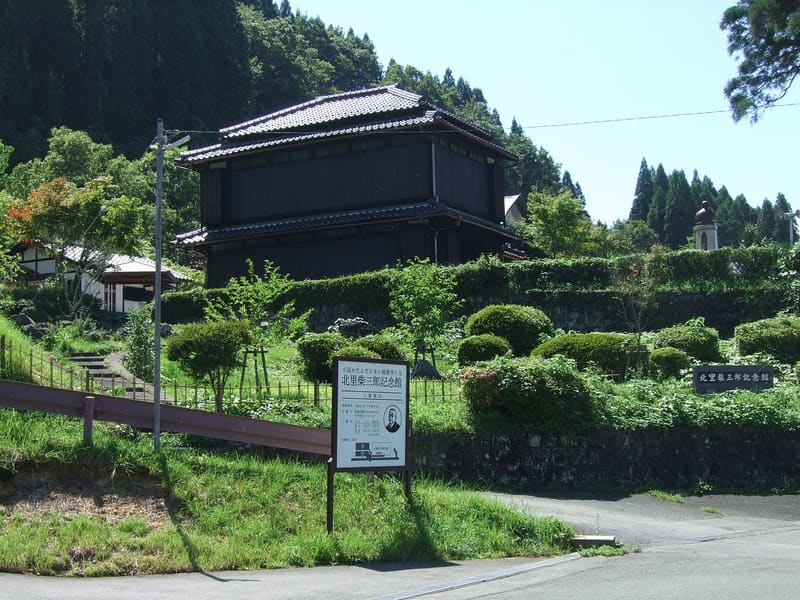
Kitazato Shibasaburō Museum (北里柴三郎記念館)
photo by Muyo · CC BY-SA 4.0

The 1916 library that Kitazato paid for out of his own pocket is now a room of the museum.

In the village where the bacteriologist Kitazato Shibasaburō was born you visit four buildings, about a quarter of an hour each: the birthplace reduced to two rooms, the Renaissance-style library of 1916, the guest residence and the multimedia hall of 2023. In the three historic buildings you enter barefoot.

Kitazato Shibasaburō was born on 29 January 1853 in Kitazato, now part of Oguni. In 1889 he obtained a pure culture of the tetanus bacillus and in 1890 developed serum therapy, in a work signed together with his colleague Behring; in 1894 in Hong Kong, where plague was widespread, he identified the plague bacillus. In 1914 he founded at his own expense the institute that bears his name; he died in 1931. His face is on the 1,000 yen banknote issued on 3 July 2024. The museum is run by the foundation 学びやの里. According to the official website the library (北里文庫) is ‘a Renaissance-style library that the doctor built with his own money for the children of the village’, in 1916 (大正5年); the guest residence (貴賓館) is from the same year and served Kitazato when he returned to the village or received guests; of the birthplace (生家) it is handed down that in 1895 it was reduced to the present two rooms when he invited his parents to Tokyo; the hall of 2023 (ドンネル館) was opened for the 170th anniversary of his birth.

ℹ️ Open 9:30–16:30 (last entry 16:00), all year except the end of the year (in 2025–26 closed from 30/12 to 03/01). Since 1 April 2025 the ticket is 800 yen for adults and university students, 400 for elementary, junior high and high school students, free under 6; groups of 20 or more 600 and 300 yen; 200 yen discount with a disability card. You enter barefoot in 北里文庫, 貴賓館 and 生家. Personal photos are allowed in the rooms and in the grounds, but photographing the exhibits in the multimedia hall and in the library, and filming the film shown in the hall, are forbidden; food and drink are forbidden in the buildings. By car or taxi: Sankō bus from Aso to the ゆうステーション in Oguni and then a taxi ride of ~5 km; from Hita IC about 35 km (Rurubu); car park for 30 cars (Rurubu). On 18/10/2026 the website's calendar showed ‘本日開館です’. Telephone 0967-46-5466.

Holidays in Japan? Plan them with us.Over 2,000 real places, a day-by-day itinerary.FreeOpen the map →

Sources: s-kitazato.jp · s-kitazato.jp · s-kitazato.jp · ja.wikipedia.org

Nearby
All series · Open the map

Kitazato Shibasaburō Museum (北里柴三郎記念館)
Open on the mapwith over 1,800 wonders of Japan
Kitazato Shibasaburō Museum (北里柴三郎記念館)
photo by Muyo · CC BY-SA 4.0

The 1916 library that Kitazato paid for out of his own pocket is now a room of the museum.

In the village where the bacteriologist Kitazato Shibasaburō was born you visit four buildings, about a quarter of an hour each: the birthplace reduced to two rooms, the Renaissance-style library of 1916, the guest residence and the multimedia hall of 2023. In the three historic buildings you enter barefoot.

Kitazato Shibasaburō was born on 29 January 1853 in Kitazato, now part of Oguni. In 1889 he obtained a pure culture of the tetanus bacillus and in 1890 developed serum therapy, in a work signed together with his colleague Behring; in 1894 in Hong Kong, where plague was widespread, he identified the plague bacillus. In 1914 he founded at his own expense the institute that bears his name; he died in 1931. His face is on the 1,000 yen banknote issued on 3 July 2024. The museum is run by the foundation 学びやの里. According to the official website the library (北里文庫) is ‘a Renaissance-style library that the doctor built with his own money for the children of the village’, in 1916 (大正5年); the guest residence (貴賓館) is from the same year and served Kitazato when he returned to the village or received guests; of the birthplace (生家) it is handed down that in 1895 it was reduced to the present two rooms when he invited his parents to Tokyo; the hall of 2023 (ドンネル館) was opened for the 170th anniversary of his birth.

ℹ️ Open 9:30–16:30 (last entry 16:00), all year except the end of the year (in 2025–26 closed from 30/12 to 03/01). Since 1 April 2025 the ticket is 800 yen for adults and university students, 400 for elementary, junior high and high school students, free under 6; groups of 20 or more 600 and 300 yen; 200 yen discount with a disability card. You enter barefoot in 北里文庫, 貴賓館 and 生家. Personal photos are allowed in the rooms and in the grounds, but photographing the exhibits in the multimedia hall and in the library, and filming the film shown in the hall, are forbidden; food and drink are forbidden in the buildings. By car or taxi: Sankō bus from Aso to the ゆうステーション in Oguni and then a taxi ride of ~5 km; from Hita IC about 35 km (Rurubu); car park for 30 cars (Rurubu). On 18/10/2026 the website's calendar showed ‘本日開館です’. Telephone 0967-46-5466.

Holidays in Japan? Plan them with us.Over 2,000 real places, a day-by-day itinerary.FreeOpen the map →

Sources: s-kitazato.jp · s-kitazato.jp · s-kitazato.jp · ja.wikipedia.org

Nearby