
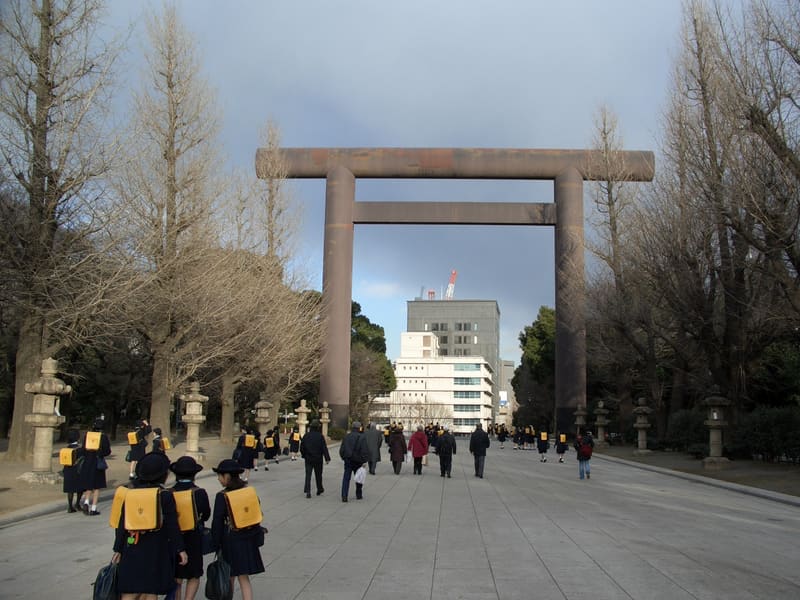
No emperor has visited it since 1975: three reigns, almost 51 years
Every day thousands of visitors pass through the great torii (the entrance gate to Shinto shrines, here 25 metres high and weighing 100 tonnes) to reach the shrine, where the eirei rest, the ‘heroic spirits’ of the war dead, as the shrine itself calls them. In the museum within the grounds, the Yūshūkan, a restored Zero fighter greets visitors on the ground floor, with free entry; the paid galleries above trace Japan's military history up to 1945.
Founded on 29 June 1869 at the wish of Emperor Meiji as Shōkonsha (招魂社, literally ‘shrine that summons the souls’), it took its current name (which means ‘pacifying the homeland’) in 1879. It honours about 2.466 million war dead since 1853, according to the latest official count made public, dating from 2004. The site describes itself as the place to touch ‘the heart’ of these fallen, also through the periodic display of their letters. Today the shrine is a private religious body, under the 1946 law that separated the state and Shinto worship after the war. On 17 October 1978 the chief priest Matsudaira Nagayoshi secretly enshrined there 14 people judged ‘Class A criminals’ by the International Military Tribunal for the Far East, the trial set up by the Allies in Tokyo after the war: the most serious category, reserved for those who planned and waged the war, distinct from categories B and C, for conventional war crimes and crimes against humanity. The news came out in the Asahi Shimbun on 19 April 1979. A 1988 note by the then Grand Chamberlain Tomita, made public only in 2006, attributes to that enshrinement Emperor Shōwa's decision never to return to the shrine; his last visit, by a chronological coincidence that historians have debated, had already taken place in November 1975, three years before the enshrinement. Neither Emperor Akihito during his entire reign, nor the current Emperor Naruhito since he came to the throne, has ever visited; according to the Japanese business press, the shrine itself gave up renewing the invitation after a refusal for the 150th anniversary. The shrine has always refused to separate the 14 from the other war dead, calling it religiously impossible. Since Prime Minister Nakasone paid an official visit in 1985, every similar visit by a Japanese minister has provoked diplomatic protests from China and South Korea, which see it as a symbol of wartime militarism; the most recent protests, on 15 August 2026 (the 81st anniversary of the surrender), were over the visit of Defence Minister Koizumi Shinjirō and the ritual offering, not an in-person visit, of Prime Minister Takaichi Sanae: the Chinese foreign ministry spoke of ‘strong condemnation’ and formal protests, the South Korean one of ‘deep regret’ over a gesture it called ‘anachronistic’. The Yūshūkan museum, reopened in its current form in 2002 after an extension, sets out Japanese military history in more than twenty galleries; historians and outside observers criticise it for a reading that, they argue, presents Japan's war policy in Asia from the thirties to the surrender in a positive tone, without accounting for its victims.
ℹ️ The shrine is open every day 6:00–19:00, free entry. The Yūshūkan museum is open 9:00–16:30 (last entry 16:00): the ground floor is free, and there is a charge for the upper floors (adults 1,000 yen, university students 500, junior high/high school 300, children free). Kudanshita Station (Tōzai, Hanzōmon, Toei Shinjuku lines), a few minutes on foot (exact distance not checked in person).
🚉 Kudanshita · 10 min walk
Holidays in Japan? Plan them with us.Over 2,000 real places, a day-by-day itinerary.FreeOpen the map →Sources: yasukuni.or.jp · ja.wikipedia.org · ja.wikipedia.org · ja.wikipedia.org · ja.wikipedia.org · toyokeizai.net · aljazeera.com · nippon.com · commons.wikimedia.org
Nearby
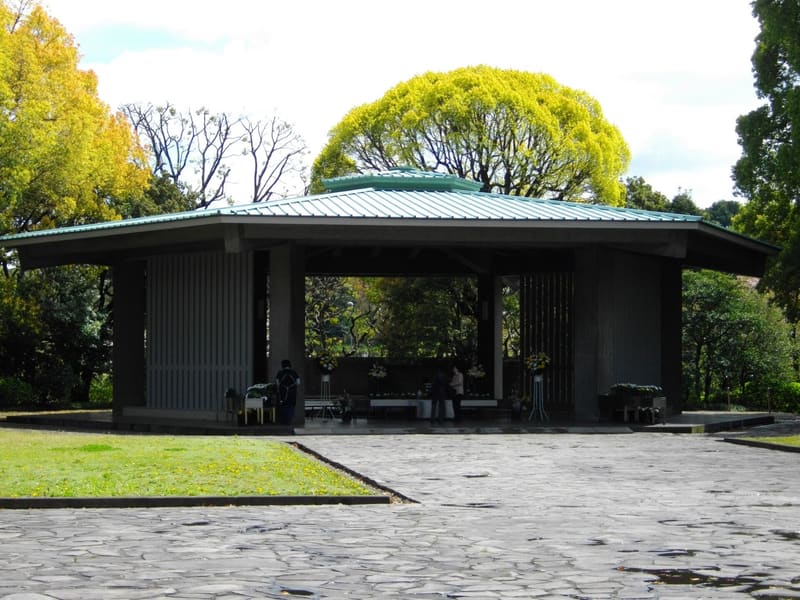 Chidorigafuchi National Cemetery for the War Dead600 mphoto by Abasaa · Public domain
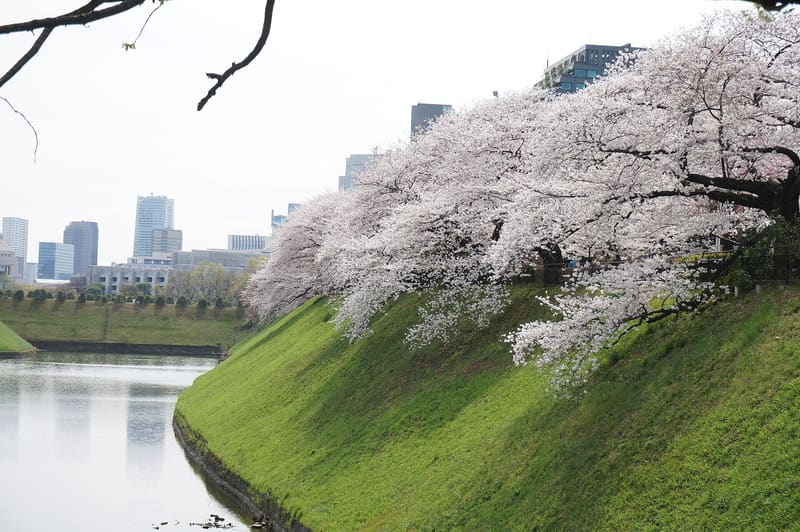 Chidorigafuchi700 mphoto by yisris · CC BY 2.0
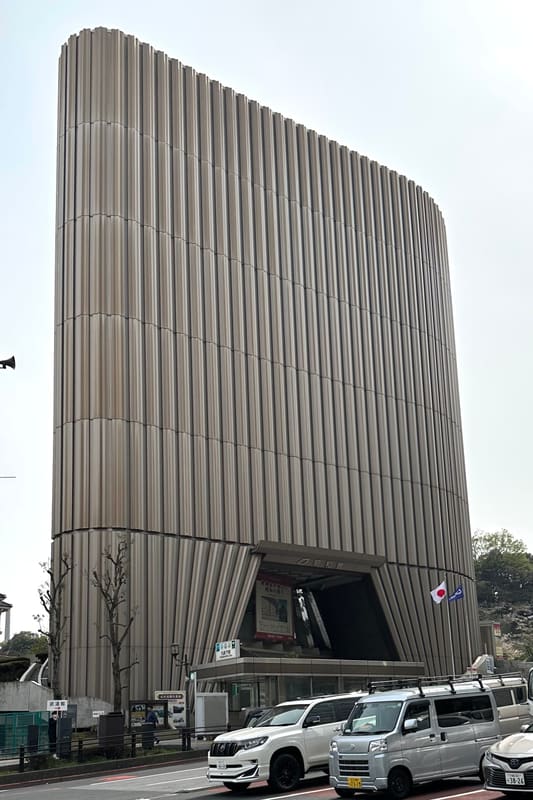 Shōwa-kan — museum of daily life in wartime700 mphoto by Olaf2 · CC BY-SA 4.0
 Tokyo Daijingu700 mphoto by Miyuki Meinaka · CC BY-SA 4.0