
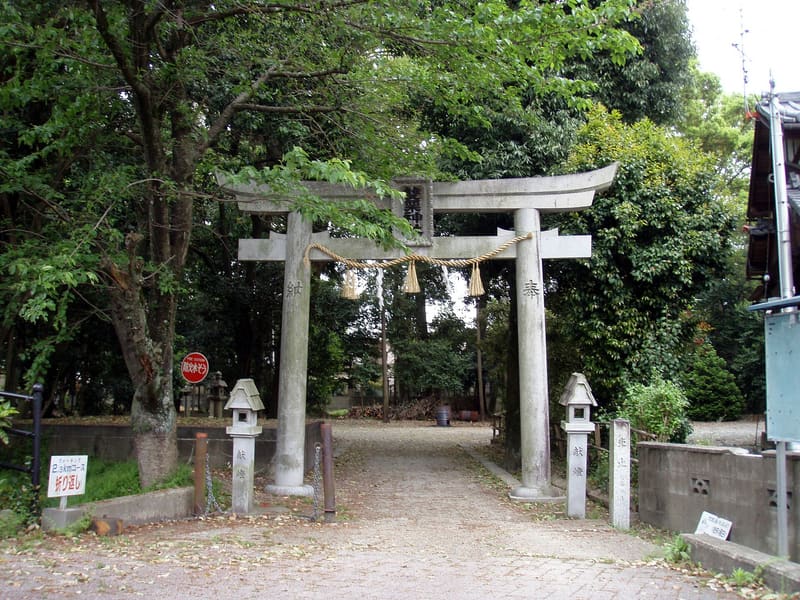
Above the side panels, squirrels among bunches of grapes, carved in the fifteenth century.
You go up to within two metres of the main building and read the carvings one by one: on one curved panel under the roof are flowers and birds, on the other maples and deer, and above the side panels squirrels among bunches of grapes. The surface is not bare wood: it is painted in full colour, inside and out. In the grounds there is a thirty-metre camphor tree, and below it a small grove of camellias.
A country shrine in the hamlet of Sayama. The main building, built around 1494, is a 三間社流造 (a three-bay plan with a roof that slopes forward to cover the steps), roofed with cypress bark, and it is a national Important Cultural Property. The interior is divided into a front hall and an inner hall and painted in colour over its entire surface; the decorative carvings are on the 蟇股, the frog-shaped panels between the beams, and above the side panels. The colour you see today comes from the 1980–81 restoration, finished in October. In the grounds grows a camphor tree about thirty metres tall and 5.35 m in circumference, protected by the municipality. Two rites have a date: the 粥占 of 15 January, at midnight exactly, in which a porridge of rice and beans is used to read the year's harvest for eight crops, and the 八朔祭 of 31 August.
ℹ️ Open grounds, no opening hours and no ticket stated. ⚠️ Two practical limits, and both matter: there is stated to be no car park, and you can only get there by bus 21 or 21A from Yodo (Keihan) or from Ōkubo (Kintetsu), 久御山団地口 bus stop, plus two minutes on foot. ⚠️ And a doubt to clear up before you go: the main building could be under a construction shelter. In the search engines’ index there is a municipal page titled ‘guided tours of the conservation restoration of the main building of Saguri-jinja’, but that page returns 404 and it was not possible to open it. Re-roofing in cypress bark involves a 素屋根, a temporary structure that covers the building for months or years: anyone arriving in that period would find scaffolding instead of the cultural property. None of the pages opened mentions it, and the most recent confirmed restoration remains the one of 1980–81. You settle it with a phone call to the municipality (lifelong learning, 075-631-9980 / 0774-45-3918).
🚉 Ōkubo · 25 min walk
Holidays in Japan? Plan them with us.Over 2,000 real places, a day-by-day itinerary.FreeOpen the map →Sources: kyoto-kankou.or.jp · town.kumiyama.lg.jp · ja.wikipedia.org · kyotofukoh.jp
Nearby
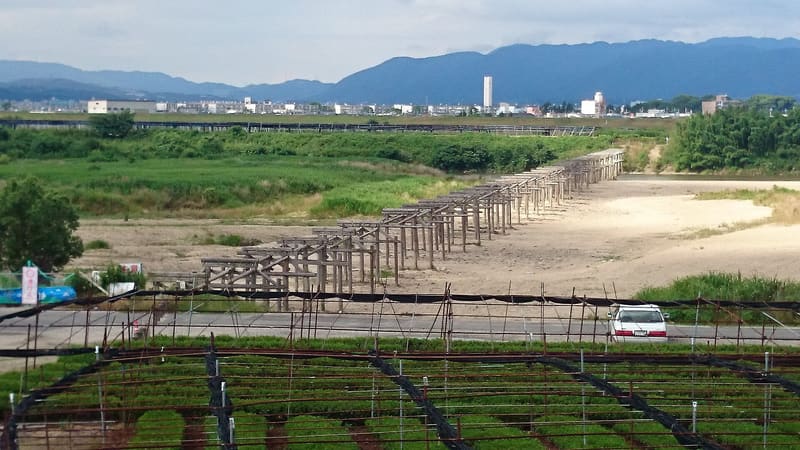 Nagare-bashi1.5 kmphoto by Nodaunji · CC BY-SA 4.0
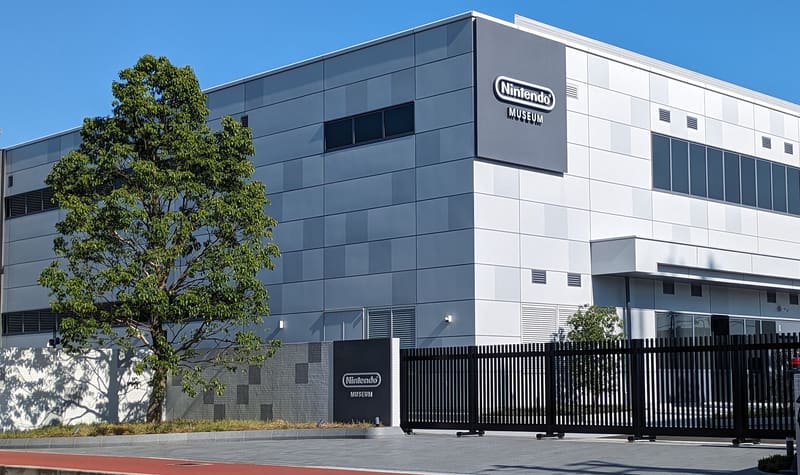 Nintendo Museum3.1 kmphoto by Nagomijirap · CC BY-SA 4.0
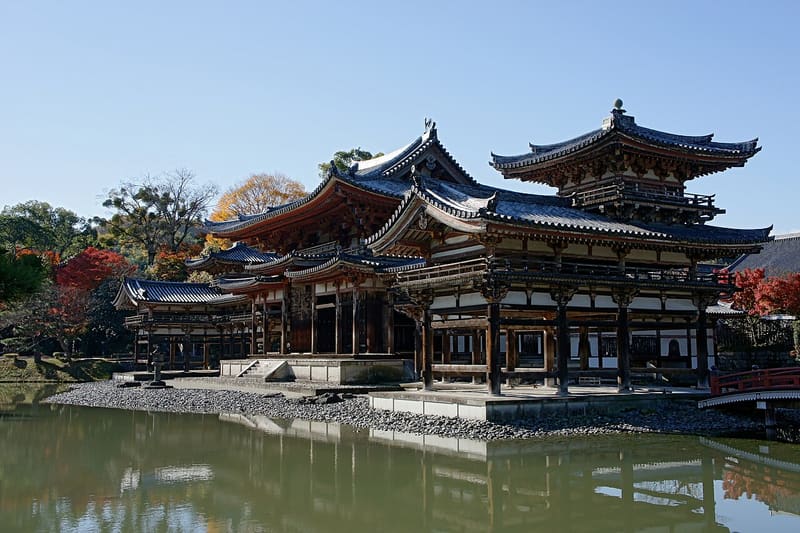 Byodo-in4.8 kmphoto by 663highland · CC BY 2.5
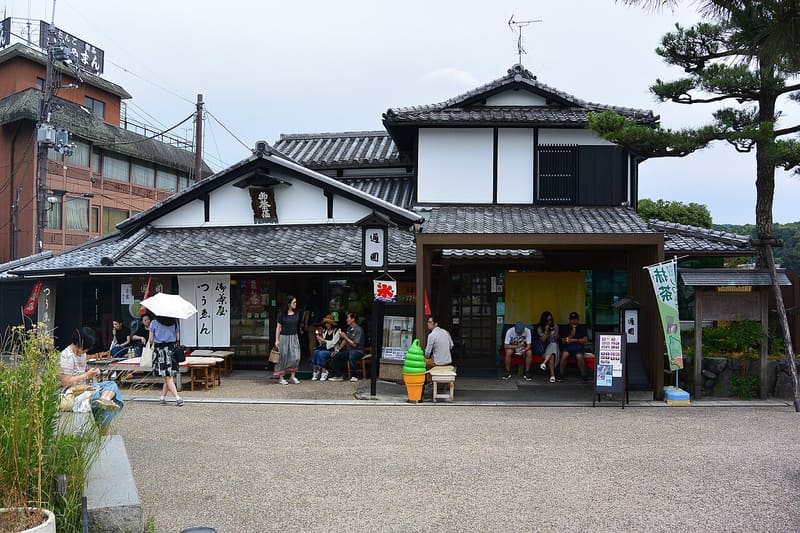 Tsuen (Uji tea house)4.8 kmphoto by Miya.m · CC BY-SA 4.0