
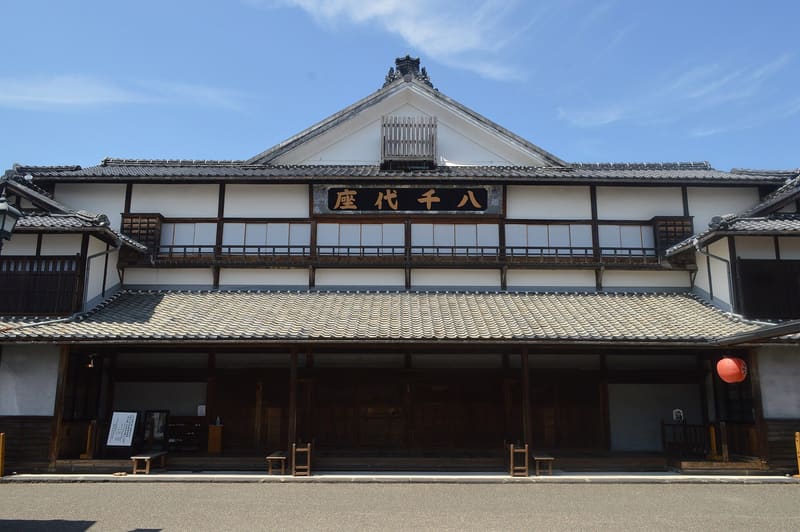
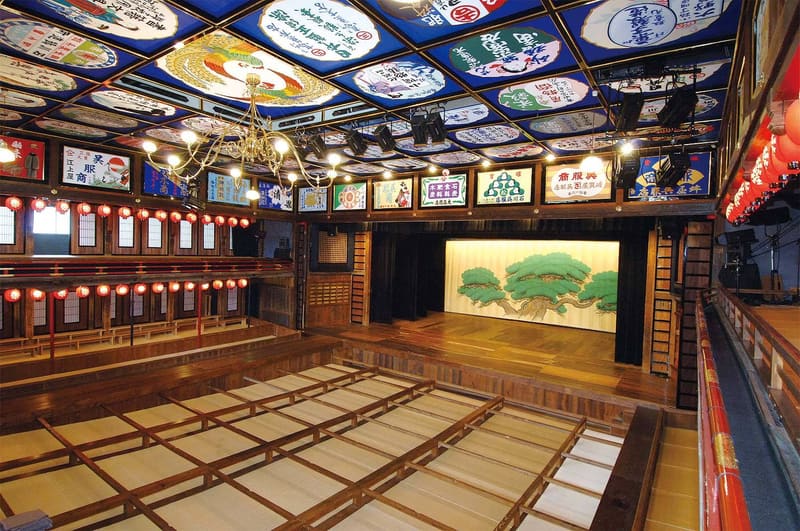
The revolving stage weighs 3.2 tonnes and is turned by hand, on German rails.
You go in wearing socks and sit on the floor in the wooden boxes, as in 1911. The ceiling is covered with advertisements painted in solid colours (the Yamaga shops that paid for the construction), and a brass chandelier hangs in the centre. Below the stage you go down into the understage, where the eight-and-a-half-metre revolving platform is pushed by hand, on rails and wheels that came from Germany.
It was built in 1910 by the merchants of Yamaga, who joined forces to give themselves a theatre; it opened to the public in January 1911. It is a traditional-style theatre for kabuki, the classical Japanese theatre, with about seven hundred seats, an auditorium 29.49 metres wide and 35.40 deep and a stage of 13.38 by 10.50. The revolving stage measures eight and a half metres in diameter and weighs 3.2 tonnes, and turns on rails and wheels made by Krupp, the German steelmaker. After decades of neglect it has been restored, and it has been a 重要文化財, a national Important Cultural Property, since 19 December 1988.
ℹ️ 9:00–18:00, last entry at 17:30. Closed on the second Wednesday of every month and from 29 December to 1 January. Tickets 530 yen adults, 270 yen elementary and junior high school pupils; 730 and 370 yen for the combined ticket with the Yamaga lantern museum. If the theatre is in use for a performance, you can visit only the museum, for 220 yen. You can walk round freely, and a member of staff explains the auditorium every hour, at around 30 minutes past. ⚠️ Earthquake of 28/07/2026: the official site states explicitly ‘八千代座は通常どおり営業を行っております。今回の地震による被害はありません’ (open as usual, no damage).
Holidays in Japan? Plan them with us.Over 2,000 real places, a day-by-day itinerary.FreeOpen the map →Sources: yamaga.site · yamaga.site · yamaga-tanbou.jp · yachiyoza.com
Nearby
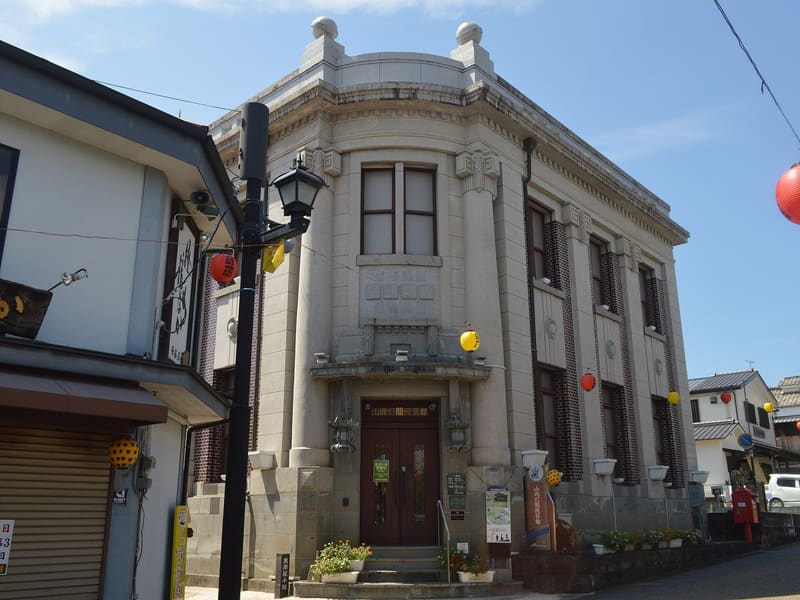 Yamaga Lantern Museum200 mphoto by Asturio Cantabrio · CC BY-SA 4.0
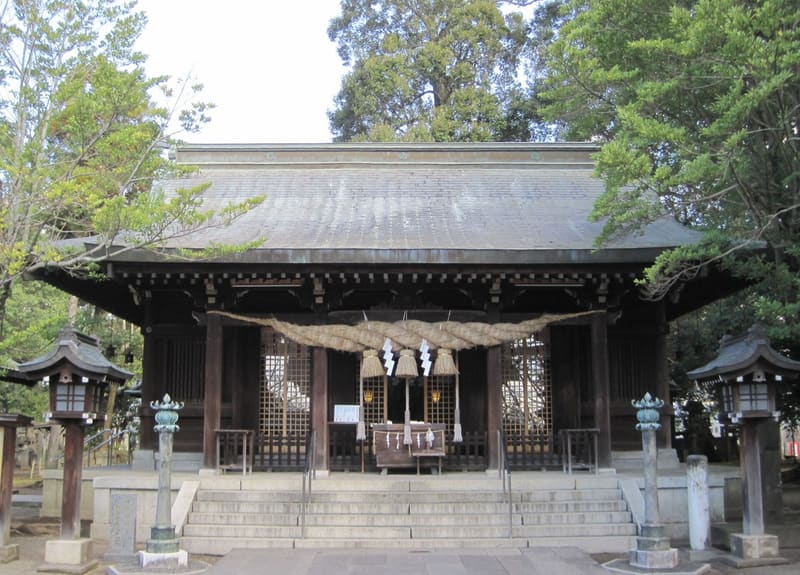 Ōmiya Shrine, Yamaga600 mphoto by Siwamura · CC BY-SA 3.0