
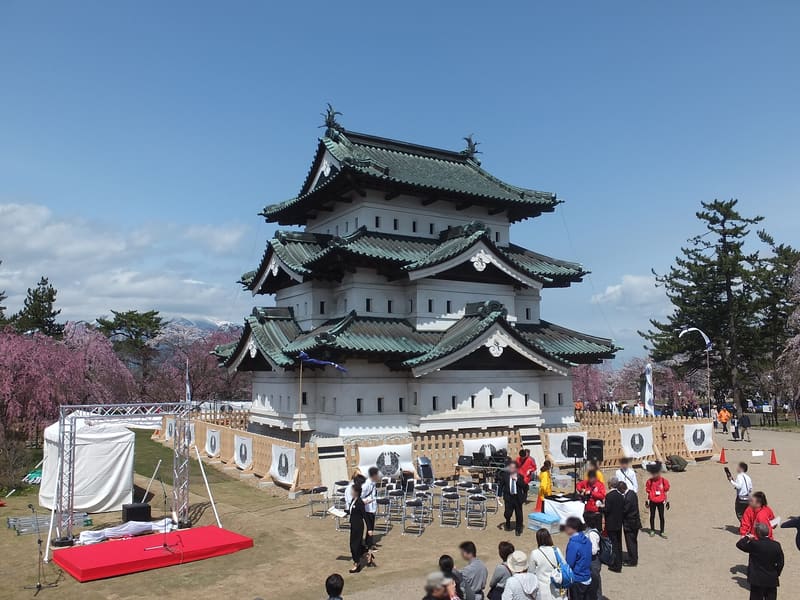
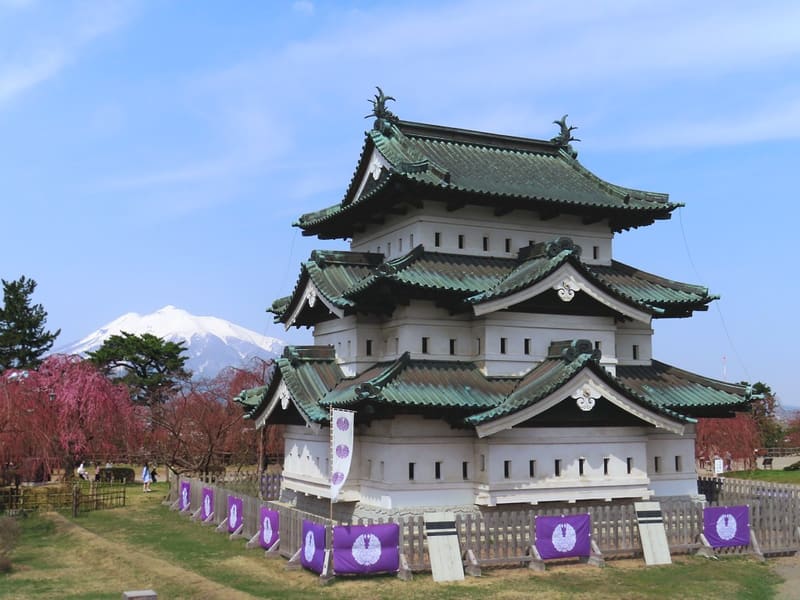
The 1810 tenshu was recorded as a ‘turret’, never a ‘castle’, so as not to offend the shogunate.
The original tenshu, built in 1611 by Tsugaru Nobuhira, burned down in 1627 after being struck by lightning; the present one, built in 1810, was officially registered as a three-storey tower (never a ‘castle’) so as not to fall foul of the Tokugawa edict on fortifications. Today about 2,600 cherry trees grow around the moat, most of them planted from 1903 onwards: the tenshu, three corner turrets and five surviving gates have been Important Cultural Properties since the post-war years.
The fortress of the Tsugaru, lords of the Hirosaki domain in the Edo period: built in 1611 and rebuilt in 1810 after the fire of 1627. Open as a public park since 1895, it preserves its tenshu, three turrets and five original gates, among the few in Tōhoku to have survived without reinforced-concrete reconstructions.
ℹ️ The park is always open, with free entry. The paid area of the tenshu (Honmaru and Kita-no-kuruwa) can be visited 9:00–17:00 from April to November and is closed from 24 November to 31 March (admission: adults 320 yen, children 100 yen; combined ticket with Fujita Garden and the botanical garden 520 yen). ⚠️ The tenshu stands on a temporary base during restoration work on the stone walls, under way since 2015 and still not finished in 2026. The cherry blossom season, typically late April, is the busiest time of the year. 30 minutes’ walk from JR Hirosaki Station, or by bus to Shiyakusho-mae (5 minutes’ walk).
🚉 亀の甲門前 · 9 min walk
Holidays in Japan? Plan them with us.Over 2,000 real places, a day-by-day itinerary.FreeOpen the map →Sources: hirosakipark.jp · hirosakipark.jp · ja.wikipedia.org
Nearby
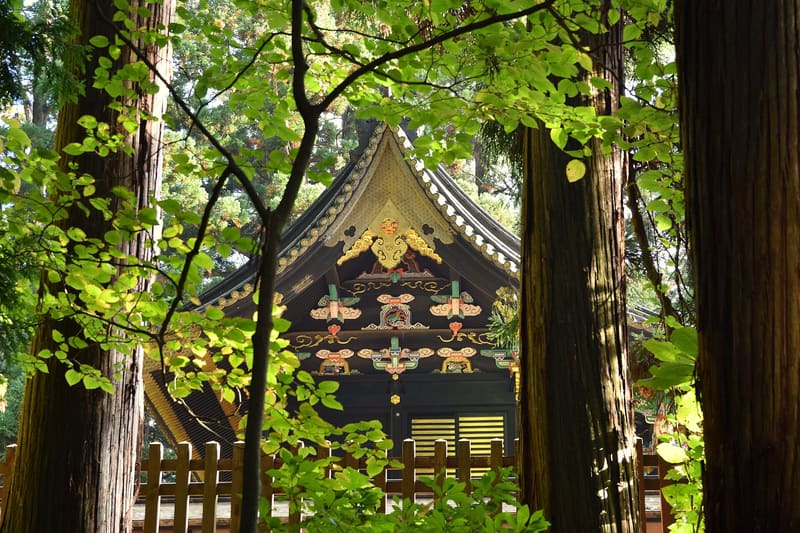 Iwakiyama Shrine10.4 kmphoto by 雷太 · CC BY 2.0