
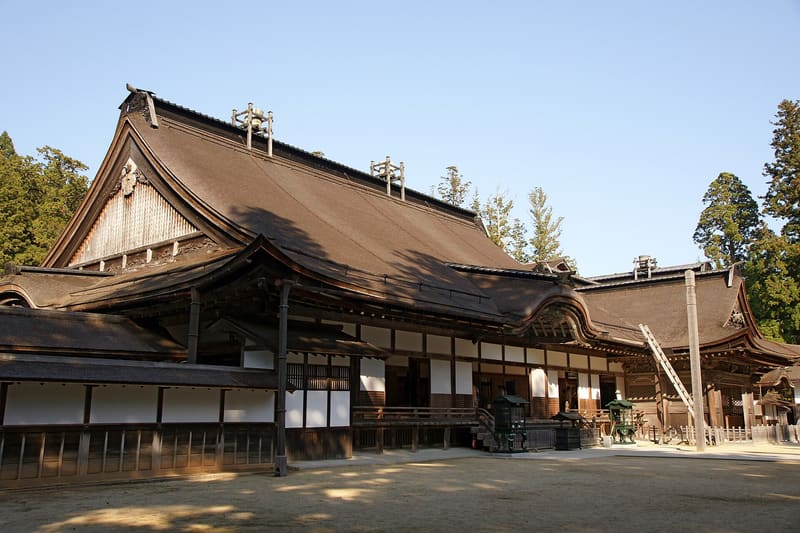
The Banryūtei, the largest all-gravel garden in Japan: 2,340 m².
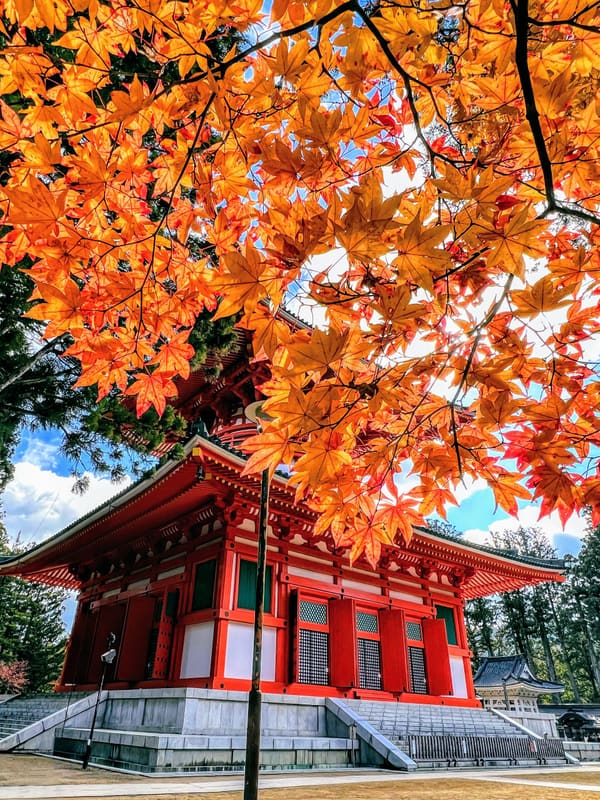
Kongōbu-ji is the head temple of the Shingon school of Buddhism, founded in 816 when Emperor Saga granted the mountain to Kūkai (Kōbō Daishi). Behind the main hall lies the Banryūtei, the largest rock garden in Japan: 2,340 square metres of raked white gravel, completed in 1984, with two stone dragons in the centre emerging from the white mist, a symbol of the temple's protection. A few steps away, in the Danjō Garan, the Konpon Daitō (the main pagoda, rebuilt in 1937) is about 50 metres tall and houses a three-dimensional mandala with the Buddha Dainichi Nyorai at its centre.
The complex is the administrative and religious heart of Kōyasan, the temple town that Kūkai founded as the centre of Shingon in 816. The Kondō (the main building of the Danjō Garan) was rebuilt in 1932 after a fire in 1926. The Fudōdō, another hall of the complex, is a National Treasure. Kōyasan as a whole (more than 2,000 temples according to general tourist sources) has been a UNESCO World Heritage Site since 2004 as part of the ‘Sacred Sites and Pilgrimage Routes in the Kii Mountain Range’, together with the Kumano Sanzan and Yoshino (the latter in Nara Prefecture).
ℹ️ Combined ticket for Kongōbu-ji and Danjō Garan (the Reihōkan, the treasure museum, needs a second ticket). Exact opening hours and price to be checked on the official site: check before you set off. Access: cable car from Gokurakubashi (Nankai station) up to Kōyasan, then local bus.
🚉 14 Okunoin-mae · 13 min walk
Holidays in Japan? Plan them with us.Over 2,000 real places, a day-by-day itinerary.FreeOpen the map →Sources: ja.wikipedia.org
Nearby
 Kōyasan — Okunoin, the mausoleum of Kōbō Daishi300 mphoto by Adam Jones from Kelowna, BC, Canada · CC BY-SA 2.0
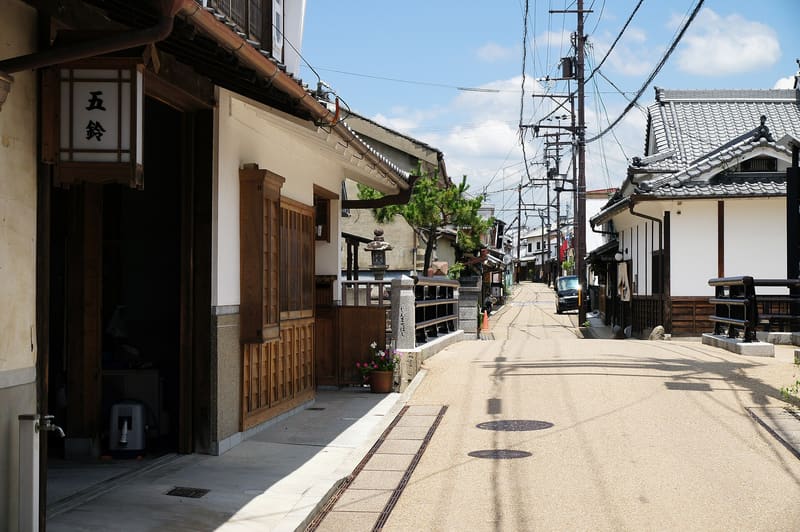 Gojō Shinmachi16 kmphoto by 663highland · CC BY 2.5