
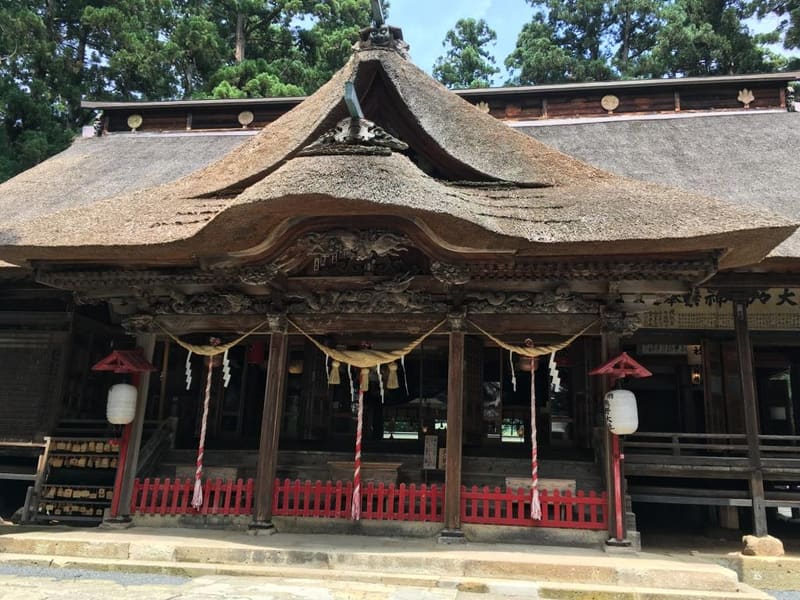
Three rabbits carved on the back grant a wish: you have to find the third one yourself.
Beyond the entrance torii, the approach path climbs among centuries-old trees to the worship hall, rebuilt in 1787 and now a prefectural cultural property; beside it grows a ginkgo about 850 years old. Three small rabbits are carved on the back of the main building: the shrine office points out where to find two of them, but the third you have to discover yourself (whoever reveals its position to others, local tradition says, sees their wish vanish).
Founded, according to tradition, in 806, when Emperor Heijō ordered it built to house the deity Kumano Gongen; a later theory instead attributes it to Taira no Koreyori, in the late Heian period (1158–1184). Raised to village shrine in 1872 and to prefectural-rank shrine in 1917, it is counted, together with the Kumano Sanzan of Wakayama and the Kumano Kōtai shrine of Nagano, as one of the three great Kumano shrines of Japan, and is therefore known as ‘the Ise of Tōhoku’.
ℹ️ Free entry to the shrine. About 60,000 visitors for the first visit of the New Year (hatsumōde). 10 minutes on foot from JR Miyauchi Station, or 10 minutes by taxi from Akayu Station; car park available. Within the grounds, the Ichō Cafe serves local dishes.
🚉 Miyauchi · 17 min walk
Holidays in Japan? Plan them with us.Over 2,000 real places, a day-by-day itinerary.FreeOpen the map →Sources: yamagatakanko.com · ja.wikipedia.org
Nearby
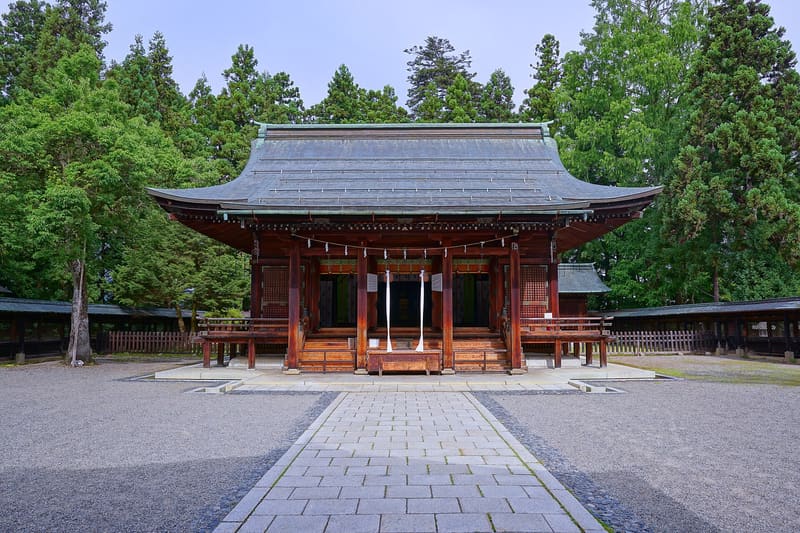 Uesugi Shrine18.9 kmphoto by 掬茶 · CC BY-SA 4.0