
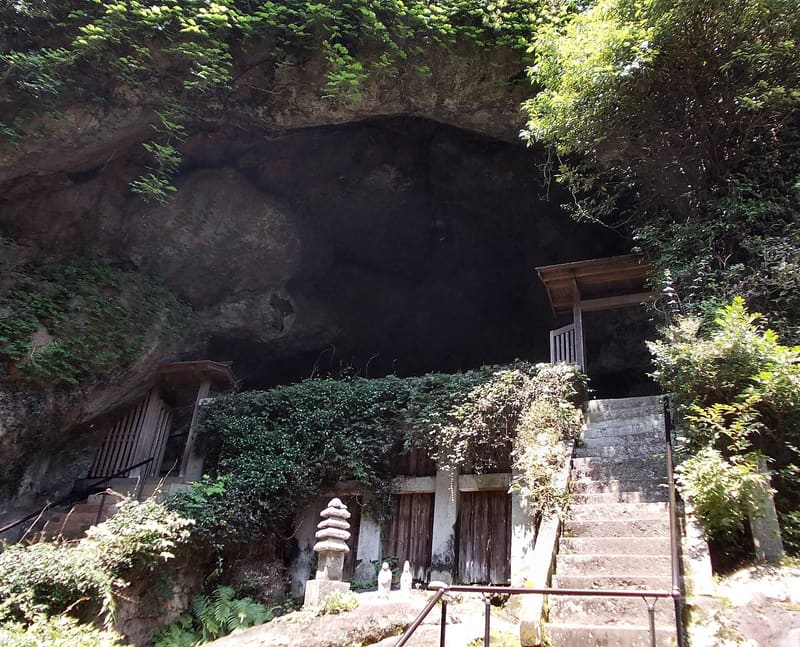
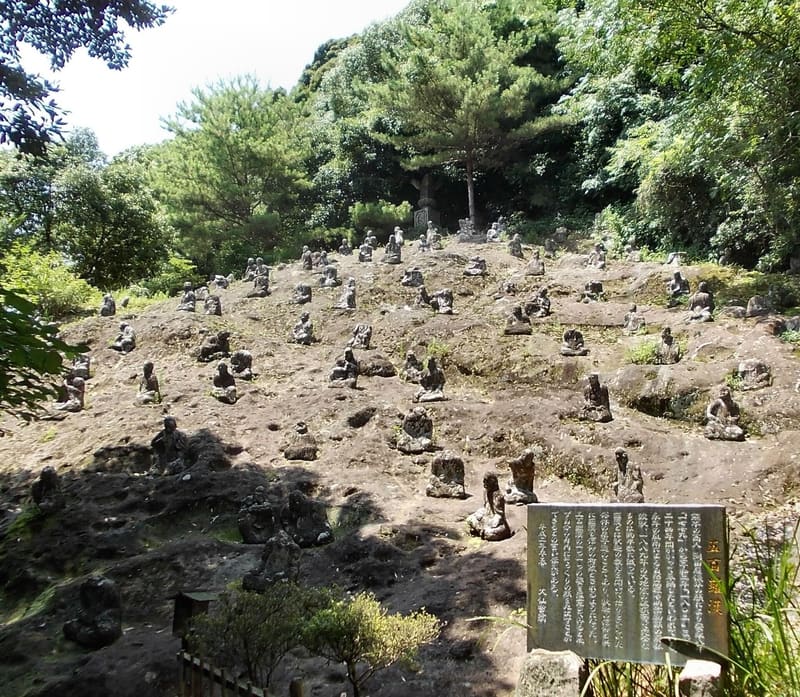
Musashi is said to have written the Book of Five Rings here; along the path, 500 stone rakan.
You pay at the office in front of the Unganzen-ji main hall and climb a path through the woods to the Reigandō, the cave where the swordsman Miyamoto Musashi is said to have written the ‘Book of Five Rings’. Along the path sit the rakan, the five hundred disciples of the Buddha carved in stone, many of them headless. Inside the cave there is a statue of Kannon, the Buddhist figure of compassion.
The Unganzen-ji is a Sōtō school Zen temple that tradition says was founded in the Nanboku-chō period (1336–1392) by the Chinese monk Tōryō Eiyo, and it is the fourteenth place on the pilgrimage of the thirty-three Kannon temples of Kyūshū. In the mountain behind it opens the Reigandō, where the Iwato Kannon is venerated: according to legend the statue came from the sea on a plank after the boat carrying it was wrecked, and the cult is older than the temple. Miyamoto Musashi (1584–1645), invited to Kumamoto by the lord Hosokawa Tadatoshi in 1640, is said to have retreated there to write the ‘Book of Five Rings’ (五輪書, Gorin no sho), a treatise on the sword and on life. The official sources differ on the length of time: the municipality's guide speaks of the last five years of Musashi's life, the national tourism agency of the last two. The five hundred rakan were donated by the Kumamoto merchant Fuchidaya Gihei, who had them carved in Saga over twenty-four years; they did not exist in Musashi's time, and many lost their heads in the early years of the Meiji era (1868–1912), when the government treated Buddhism as a foreign religion.
ℹ️ Open 8:00–17:00; the municipality's page gives no closing days (municipal list of 02/10/2026: ‘Open 8AM-5PM’). Ticket 300 yen adults, 200 high-school students, 100 up to junior high; cash only according to jeepe. You pay at the office in front of the main hall; from there the path has worn stone steps covered in moss, slippery after rain: non-slip shoes are needed. From the Sakuramachi terminal the Sankō bus takes about 30 minutes to the stop 岩戸観音入口, then 20 minutes on foot; services are few (jeepe: two in the morning on weekdays) and the timetable cannot be read as text, so in practice car or taxi: about 30 minutes from Kumamoto JR station. Free car park, 5 spaces for large vehicles and 30 for small ones. For groups of more than 30 people a guide can be requested, with notice beforehand.
🚉 平公民館 · 15 min walk
Holidays in Japan? Plan them with us.Over 2,000 real places, a day-by-day itinerary.FreeOpen the map →Sources: kumamoto-guide.jp · kumamoto-guide.jp · kumamoto-guide.jp · mlit.go.jp · city.kumamoto.jp · jeepe.jp
Nearby
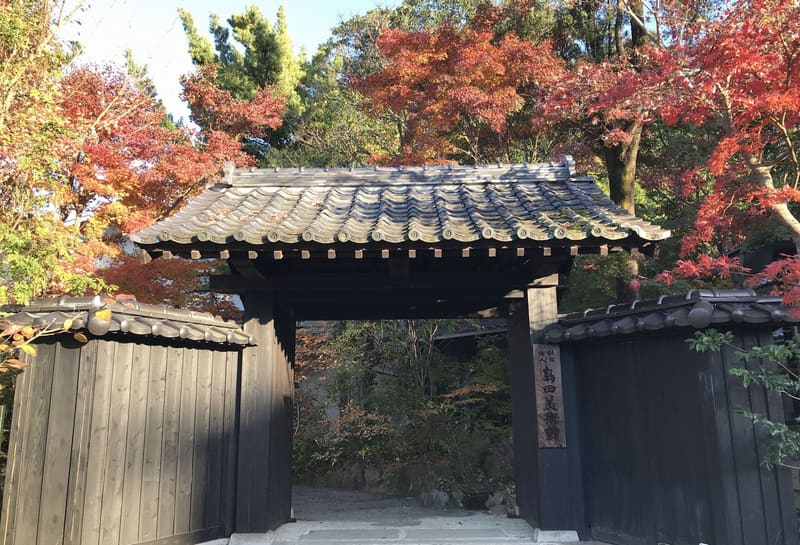 Shimada Art Museum6 kmphoto by Siwamura · CC BY-SA 4.0
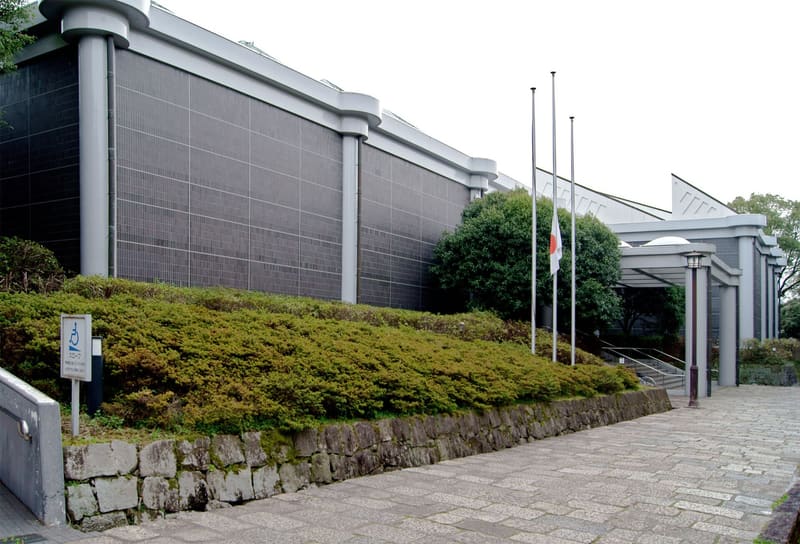 Kumamoto City Museum7.3 kmphoto by Motoki-jj · CC BY-SA 3.0
 Sakura no Baba Jōsaien7.6 kmphoto by そらみみ · CC BY-SA 4.0
 Kumamoto Castle7.9 kmphoto by Suicasmo · CC BY-SA 4.0